
A closet for what you own and what’s next.
Threadit is a digital wardrobe and styling app concept designed to help people feel more confident about what they wear. I designed its Closet experience, bringing wardrobe browsing, wear counts, and Wishlist together so clothing decisions start with what someone already owns.
Best Overall · Design Interactive Spring 2026

- My role
- Designer · Closet experience
- Context
- Design Interactive Cohort
Spring 2026 - Deliverable
- Closet design and prototype
- Team
- Sidney Heng — Design Lead
Nathan Salas, Grace Asuncion, Jared Martinez, and Emily Wu — Designers
A digital wardrobe for more confident dressing.
Threadit helps people organize the clothes they own, keep track of pieces they want, and bring that context into everyday styling decisions. The Closet is the foundation: a place to browse a personal wardrobe and return to it when deciding what to wear or buy.
Our research pointed to a deeper challenge than finding clothing. People collected style inspiration but struggled to see how a look could work for them, with their body, identity, and existing wardrobe. We began with an outfit-identification idea for Netflix viewers; surveys and interviews led us toward a broader question about confidence.
How might we help people turn style inspiration and the clothes they own into outfits they feel confident wearing?
From identifying outfits
to supporting personal style.
Our early idea was to identify where clothing came from while people watched shows. Although respondents noticed outfits on screen, their main inspiration came from social platforms. We moved away from a Netflix-specific feature toward a broader wardrobe and style experience.
35 respondents preferred saving a look for later; 6 would pause in the moment. This made a save-and-return interaction worth exploring in the broader concept.
- 43 of 63
- Sometimes or always noticed on-screen outfits they wanted to wear.
- 17 of 63
- Had searched for something a character was wearing.
Where inspiration came from
Reported source counts · 63 survey respondents
- 47
- 44
- TikTok
- 32
- Friends
- 27
- TV & film
- 10
Most respondents were 18–24 students. Of the 63 respondents, 37 reported watching Netflix at least weekly. These exploratory results are separate from the wardrobe survey below.
Wardrobe survey · 74 respondents
- 95%
- Discovered fashion through online sources.
- 72%
- Had full wardrobes but felt they had nothing to wear.
- 51%
- Had purchased clothing they barely wore.
From collecting inspiration
to using it.
The survey showed the disconnect between inspiration, purchases, and everyday wear. Our qualitative notes helped unpack it: saving a look did not necessarily lead to wearing it, and liking it on someone else did not make it easy to picture on yourself.
- Interview notes
- Four participant summaries covering saving habits, shopping decisions, and how people relate inspiration to themselves.
- Thematic synthesis
- Bringing interview notes and secondary research together around recurring tensions.
- Problem framing
- Exploring “How might we” questions around turning inspiration into personally relevant outfits and purchases.
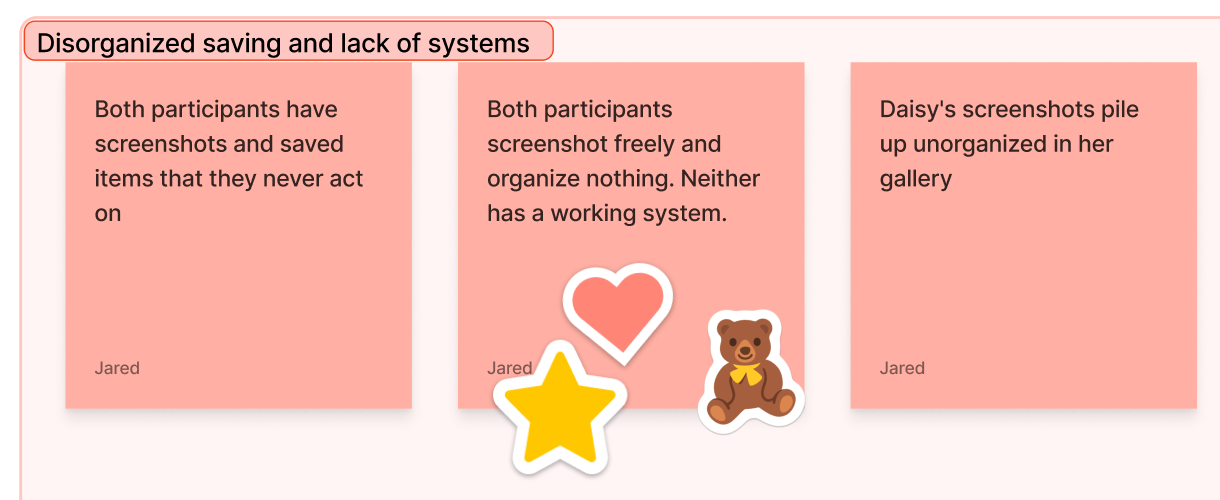
Saved, then forgotten.
Interview notes described screenshots and saved items that were never revisited, with no consistent way to organize them.
View research details ↗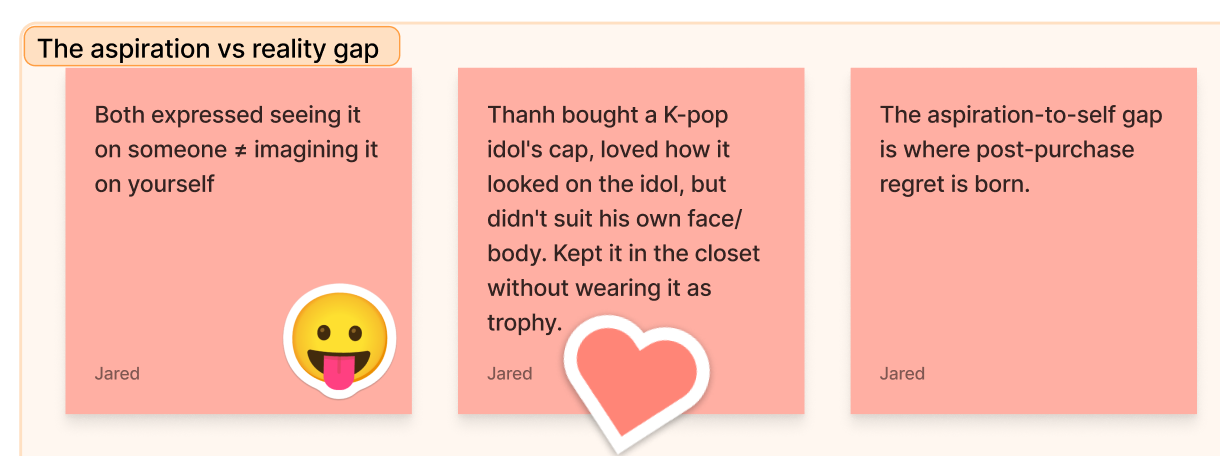
Inspiration needs context.
Seeing a piece on someone else did not always translate into confidence about wearing it. One purchase remained in the closet, unworn.
View research details ↗Selected excerpts from our team synthesis board · AI-assisted grouping of interview notes and secondary research.
What the interviews added.
- 4 of 4
- Had difficulty reliably finding clothing seen in media or online.
- 4 of 4
- Valued seeing outfits on someone with a similar body or identity.
- 3 of 4
- Experienced a gap between discovering inspiration and acting on a purchase.
The interviews shifted our focus from finding a product to helping people decide whether a look felt right for them. For my Closet work, I translated that intention into clearer access to owned clothing and a way to consider wanted pieces in the context of an existing wardrobe.
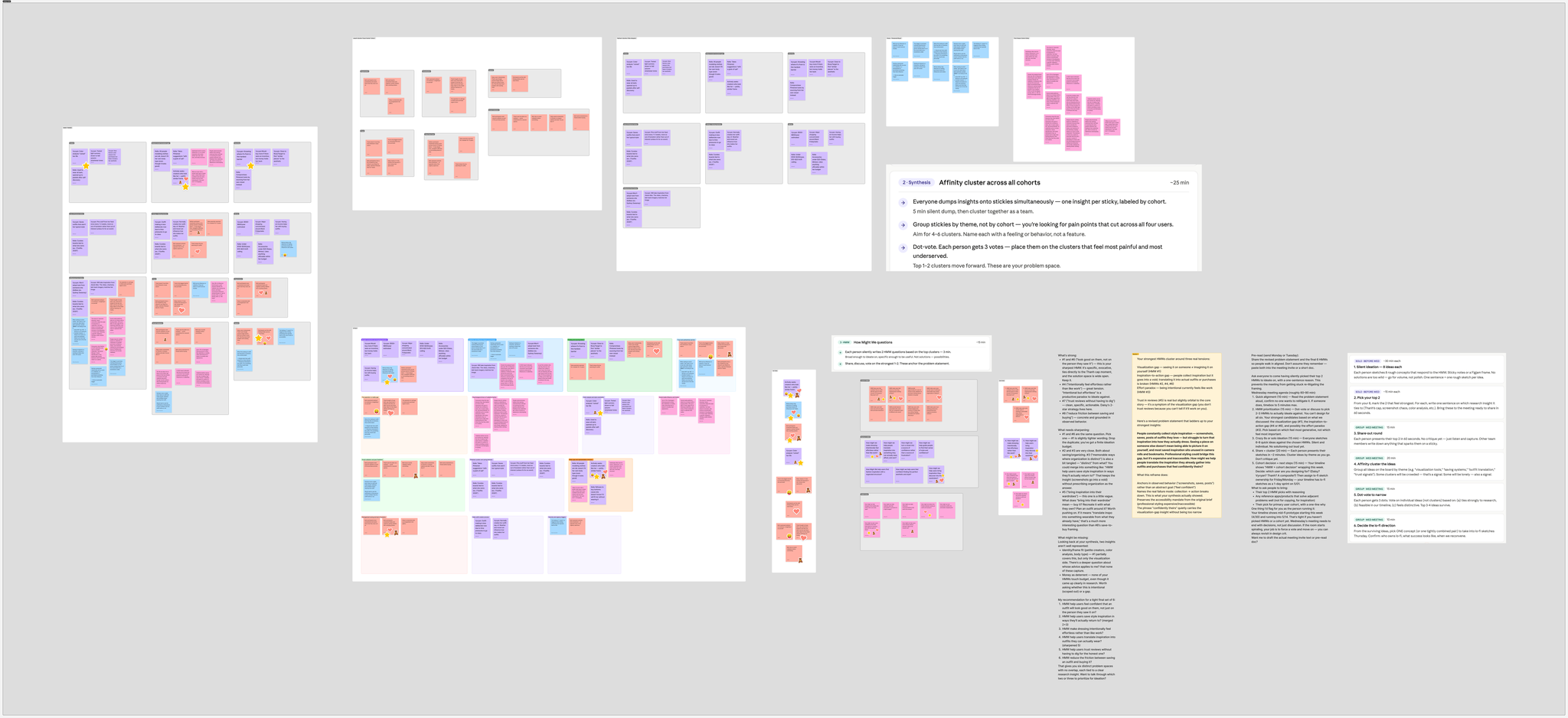
Ideation & synthesis
From research themes to a shared design direction.
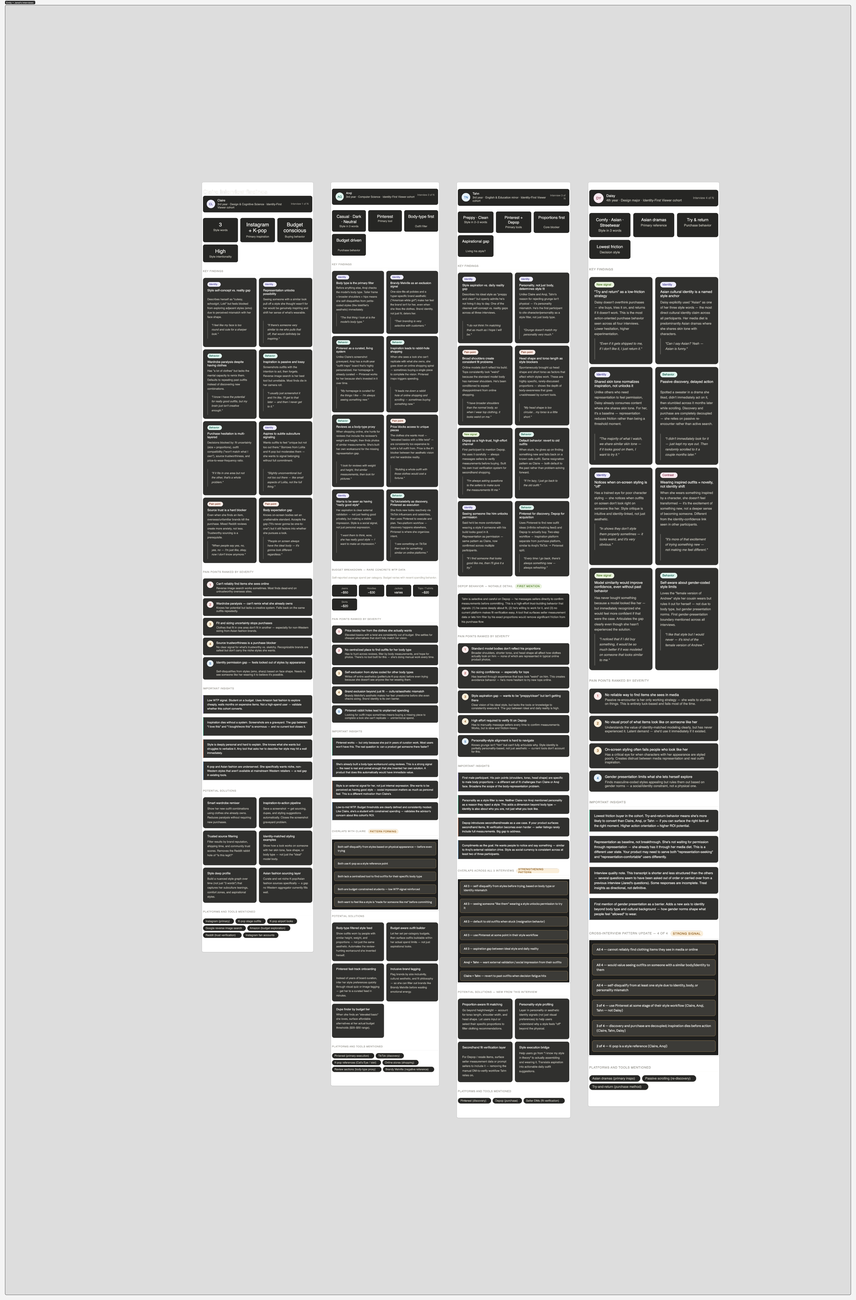
Interview synthesis
Four perspectives, with patterns gathered across interviews.
Confidence became
a design criterion.
I used the research to ask what each Closet decision could help someone feel more certain about: finding a piece, recognizing what they actually wear, or deciding whether something new belongs in their wardrobe. That intention guided my mid-fidelity exploration and the later addition of Wishlist beside Wardrobe.
Designing the closet experience.
I designed Threadit’s Closet page to give users a clearer starting point for dressing and shopping. My work focused on making owned clothing easy to find, bringing wear history into view, and connecting future purchases to a personal wardrobe.
From browsing
to adding a piece.
I explored how users would browse their wardrobe, open a piece to see its details, and add a new item. These mid-fidelity screens show three distinct parts of my Closet exploration, before the final visual design.
I translated the research into three tasks: scan what I own, understand a piece, and add it to my wardrobe. The grid supports browsing, item details provide context, and the add-item form gives each piece a consistent structure. These screens established the foundation before I refined the final Closet.
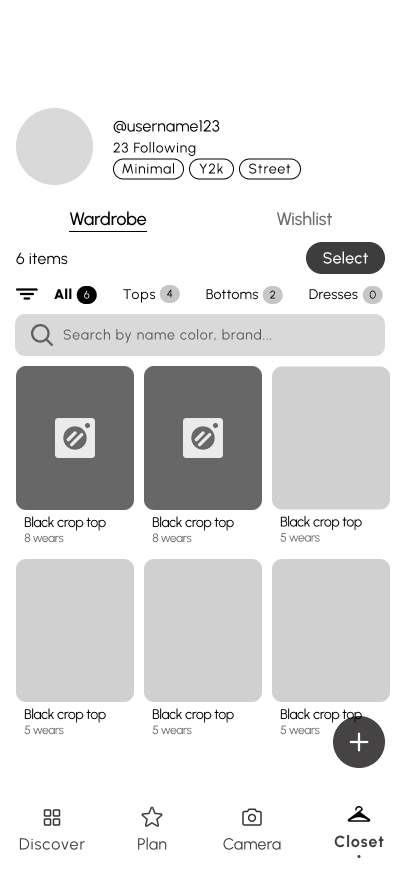
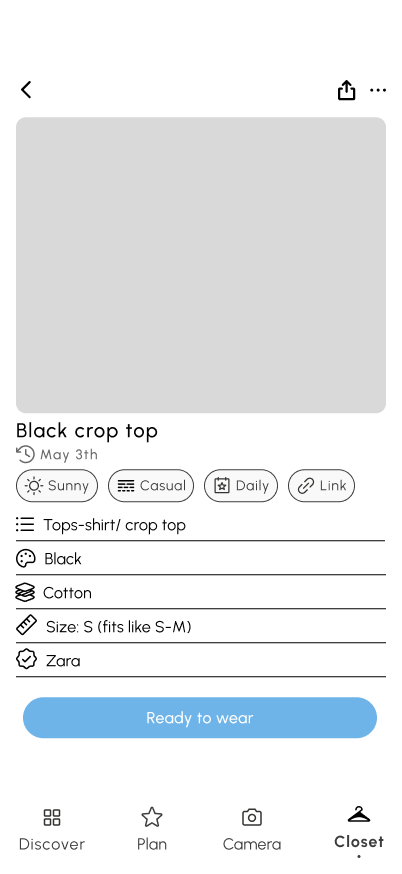
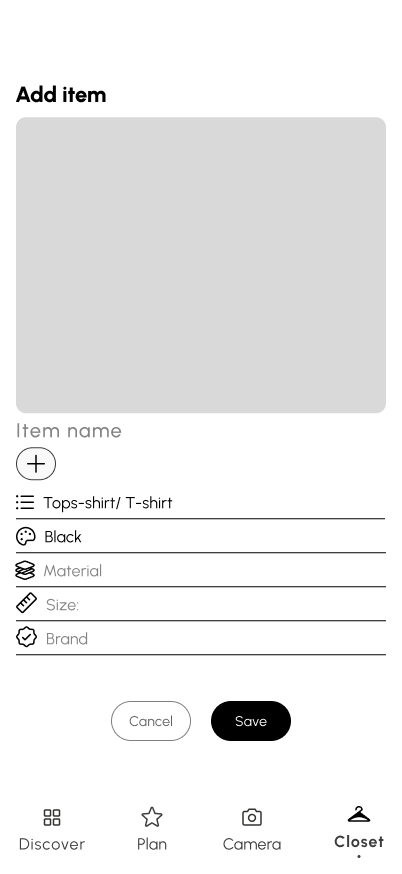
Find a piece.
Saved inspiration was difficult to act on. Categories, filters, and search give users a direct way to find clothing they already own when considering a look.
See what gets worn.
Research surfaced full wardrobes and barely worn purchases. Wear counts make familiar and overlooked pieces visible, giving users context for what they reach for and what they could revisit.
Keep a personal context.
Interviews connected style confidence to personal identity. The final Closet includes a profile and style tags, keeping the wardrobe connected to the person using it.
More context.
More considered choices.
After feedback, I added Wishlist beside Wardrobe. The Closet evolved from a view of owned clothing into a place to compare what someone has with what they are considering. Switching between the tabs lets users ask whether a piece fills a gap, duplicates an existing item, or fits the wardrobe they want to build. This iteration connects our confidence goal to a concrete decision, with more context before buying.
Wardrobe and Wishlist, together.
The revised Closet includes adjacent Wardrobe and Wishlist tabs, with a user profile above.
Final Closet design
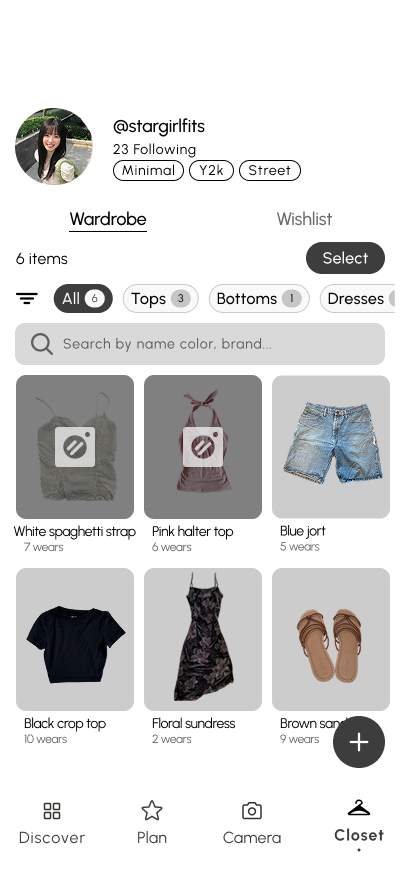
From what I own to what I’m considering.
Wardrobe and Wishlist are adjacent tabs within the Closet. This recording shows switching between the two and browsing clothing categories.
One space.
Two perspectives.
I brought owned and wanted clothing into the same area of the app, so users can move between the two while considering a purchase.
A prototype of my Closet design.
Best Overall at Design Interactive.
Our team received the Best Overall award in the Design Interactive Spring 2026 cohort. A central intention of the project was to make the transition from research to design decisions and iterations clear, with confidence guiding the experience. My Closet contribution put that intention into practice through easier wardrobe reference and more considered choices about what to add.